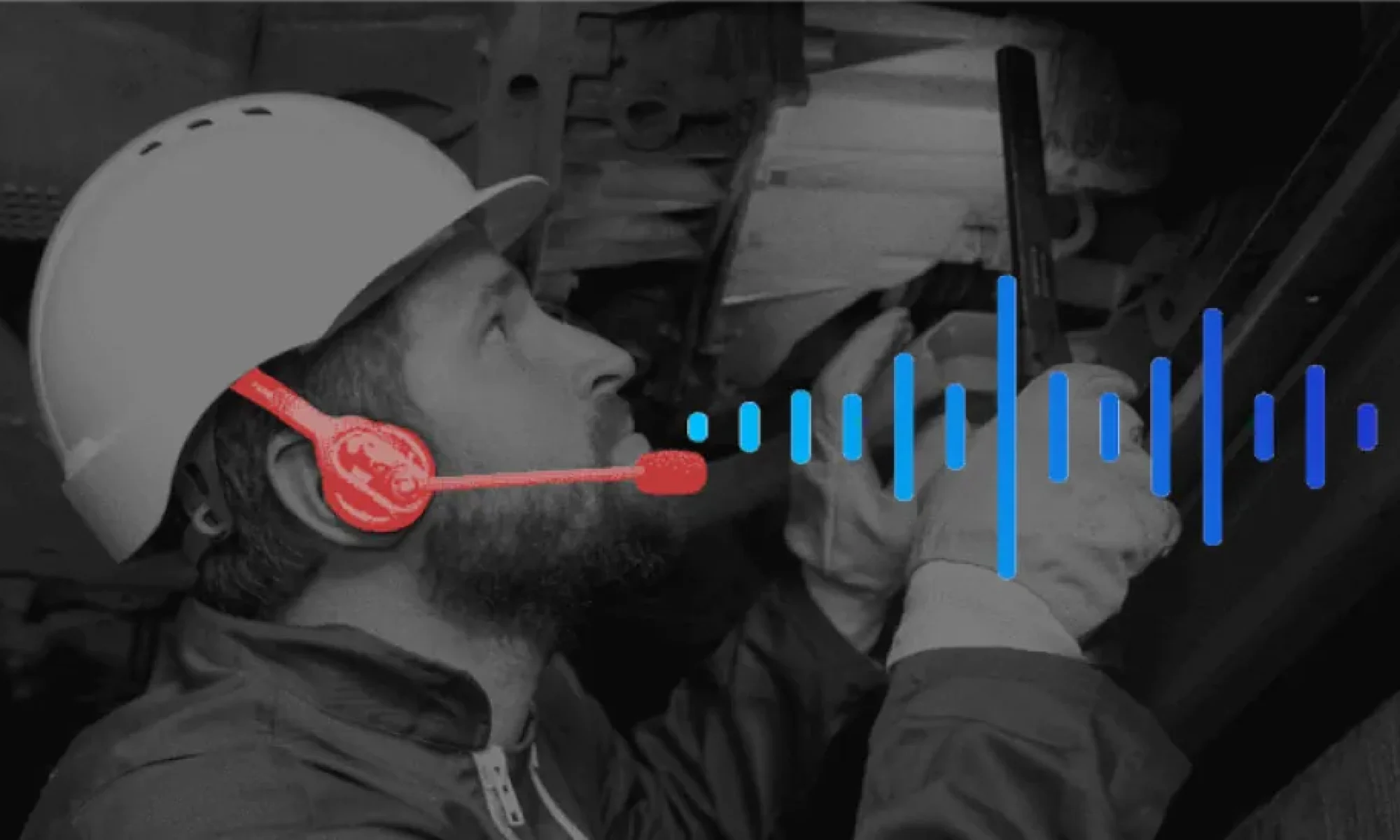
Generative AI and the industrial worker: a tale of hype and missed opportunities
In an engaging conversation, Masha GUERMONPREZ and André JOLY review the latest news on industrial AI, the hope brought by these promising technologies, and the disillusionment caused by the industry’s structural barriers. On an optimistic note, they propose an alternative approach to overcome the identified obstacles and finally achieve the value of AI solutions in industry.
Introduction
Let’s be honest: while Silicon Valley’s elite trade million-dollar prompts for generative AI, the industrial worker—helmet on, hands stained with grease—has barely noticed the revolution. ChatGPT may write poetry and debug code in milliseconds, but Jean-Pierre at the power plant? He’s still scrolling through PDFs on a cracked tablet to find that one maintenance protocol buried on page 127.
Welcome to the real digital divide: not between countries, but between professions.
The myth of universal digitalization
For years, digital transformation has been the buzzword echoing in boardrooms. The promise? Sleek interfaces, predictive maintenance, “Industry 4.0.” The reality? A patchwork of outdated systems, incompatible databases, and workers navigating a Frankensteinian mix of Excel sheets and paper logs.
Yes, some factories now sport fancy dashboards. Yes, predictive analytics exists in dedicated industries or in pilot projects. But walk into most production sites, and you’ll find a digital ecosystem duct-taped together, running on aging infrastructure, tribal knowledge, and high hopes for a better tomorrow.
Here’s the truth we will have to face sooner or later: boards chant “Industry 4.0”, but on the ground, the digital transformation of industrial sectors is patchy, slow—and frankly, underwhelming.
Consequence for the boards: a bad ROI on the digital transformation.
Low scores, high expectations
A survey of French industrial leaders—across food processing, aerospace, automotive and pharma—revealed that 43.3% rated their plants’ digital maturity just 3/10, while only 13.3% dared to give a 6/10 or above (Mercateam – 1). Is it really a technological disruption or more of a digital rabbit hole?
In France, while 58% of industrial companies have at least started digitalization projects, only 52% of SMEs achieve basic digital intensity—below the EU average of 57.7% And when it comes to AI adoption, only 5.9% of French companies have embraced it—well under the EU average of 8% (McKinsey & Company – 2)
Meanwhile, markets continue to boom on paper: France’s digital transformation sector is expected to hit around USD 40 billion in 2025, growing at 17.7% CAGR toward USD 91 billion by 2030 (Mordor Intelligence – 3). Great headline—but the main question remains: will this investment actually transform the way the workers do their job on a daily basis or just go down the bottomless well of pilots never to come to life?
Ambitions vs. Execution: the disconnect
Yes, 87% of CEOs flag digital disruption as critical to the business—but only 44% feel prepared for it (Gemini 2025 – 4). And despite the hype, over 70% of digital transformation initiatives fail—not for lack of vision, but due to fractured systems, poor strategy alignment, and cultural misfit (Whatfix 2025 – 5).
Key barriers holding digitalization hostage
According to Forrester’s recent survey of 500 manufacturing leaders, 98% report serious data challenges that block AI innovation before it even starts (Amazon Web Services – 6).
Those obstacles are painfully real:
- Fragmented, siloed data winding through legacy systems—data locked in proprietary, incompatible formats, and the—hypertrophied—power of IT departments, frustrate integration and analytics.
- Resistance to change, especially from frontline workers—or from their management to be honest—accustomed to paper logs or Excel—real adoption must battle culture and years of outdated practices, not just tech.
- Budget constraints and unclear ROI—digital pilots may impress in labs, but making the case for scaling remains tricky business (McKinsey & Company – 7), especially when dealing with exogen innovations applied to productive processes (SPIX industry – 8).
- Skills gaps and digital illiteracy—only 56% of EU citizens have basic digital skills, and the scarcity of ICT specialists slows transformation down further. Such figures might be even worst while talking about blue-collars and field workers of the industry, hence increasing the need for reskilling and up-skilling of the workforce (European Commission – 9).
Moreover, there is an issue of trust – 56% of leaders express fears and doubts in AI’s accuracy—manufacturers are holding back projects due to fears of hallucinations or unsafe recommendations (Reuters – 10).
Why raw Gen AI solutions don’t cut it
Most industrial work doesn’t need full generative AI
It sounds glamorous—generative AI on the factory floor! —but let’s be real: most industrial workers don’t need a voice assistant capable of writing sonnets about ball bearings or generating a 500-word answer about thermodynamics.
They don’t want long-winded answers. They want the right three words, at the right time, at the right (not always connected) place.
The factory is not a place for abstract ideation. It’s a place for clarity, conciseness, and concrete tasks. Which is partly why full-blown large language models (LLMs)—as powerful as they are—often miss the mark in this setting.
Why LLMs struggle in industry
Large Language Models (LLMs) seem to be ill adapted and too expensive.
▪ Connectivity constraints: LLMs typically require cloud access or powerful—expensive—servers. Many industrial sites have spotty Wi-Fi, strict firewalls, or even no connection at all.
▪ Latency: Delays of even a few seconds make them unusable in time-critical environments, or time pressured production processes.
▪ Overkill: Most questions don’t require deep generation—just recall, summarization, or short structured output. Or just an action in an app.
▪ Hallucinations are unacceptable: In the factory (read: near power lines or petrochemical equipment) even one wrong suggestion can be dangerous. And generative AI is known to be not fully predictable, unless significant investments are made to fine tune it to specific—unscalable—topics.
Why SLMs might be a better fit
Small Language Models (SLMs) offer a more realistic, grounded solution.
- Deployable on edge devices: They run locally, with no reliance on cloud infrastructure. We can expect to have them embedded as well in the near future.
- Fast, responsive, and silent: They don’t need to generate long paragraphs—they return short, accurate insights based on pre-built site-specific knowledge.
- Easier to fine-tune: You can train them on your own SOPs, repair logs, part codes, and internal jargon—without exposing sensitive data to the internet, and at reasonable costs.
- Built for structure: SLMs shine when parsing natural speech into structured reports, checklist validations, and contextual queries—hence adding real value by its simplicity of use on the shopfloor.
And voice assistant in all that?
Once the intelligence is right-sized, the interface matters. Mobile apps and dashboards aren’t designed for mechanics balancing on scaffolding with gloves on (SPIX industry – 11). What they need is to keep their hands free and their eyes on the task: leveraging the voice is perfect for that, combined with a context-aware assistant that listens more than it talks.
In the factory, here’s what that means:
▪ Procedural guidance: An operator can say “Walk me through purging Line 4,” and the assistant walks them through, step by step, checking for safety flags, and asking for confirmation before risky steps. Unlike a static checklist, it adapts based on environment, status, or even the worker’s level of experience.
▪ Fast checklist checks: No more tapping through 27 individual items while your gloves smudge the screen. During a quality check, you can say:
“ All visual components are good, no abnormalities, fluid levels are OK . »
And the wizard analyzes, checks, and marks all relevant items on the checklist. You don’t click boxes, you confirm the results.
▪ Structure information on the fly : while walking around a site, the operator can speak naturally:
” I just checked pump 2A, it’s still clicking a little, but the pressure is stable. It might be the same problem as last month. The temperature is a little high but within the range. Let’s keep an eye on it. . »
The assistant listens, understands and transforms this into a structured report:
- Equipment checked: Pump 2A
- Description: Noted rattle
- Pressure: Normal
- Temperature: Slightly high
- Recommended actions: monitoring
This is where AI genuinely changes work: not by dazzling with creativity, but by reducing friction in the everyday. It’s not here to cause a revolution, but to close the gap between the workers and the digital transformation, with the introduction of alternative—and complementary—interfaces to complex systems.
What’s blocking?
So, if AI is so smart, and if right context aware voice assistants could save time, money, and stress—then why isn’t every factory humming along with its own SML sidekick?
Because industrial reality isn’t a Linkedin article.
The truth is, the revolution isn’t blocked by technology. It’s blocked by everything around the technology.
▪ Legacy systems that refuse to die
First, the undead: legacy systems that were built when pagers were cutting-edge. You can’t plug an AI model into a control system that still runs on Windows XP and hope for the best. You can barely open half the files without a ritual sacrifice to IT.
And you can forget about integrating that voice assistant unless it speaks fluent PLC, reads ancient blue prints, and doesn’t mind crawling through patchy Wi-Fi in a windowless warehouse.
▪ Innovation, meet inertia
Second: cultural resistance. Industrial work is built on experience, instinct, and tradition. And for good reason— so many things depend on things working exactly the way they’ve always worked.
So when you show up with your shiny assistant and tell Jean-Pierre it can help him troubleshoot the turbine, he’ll look at you the way you’d look at a stranger trying to teach you how to tie your own shoes. He knows how to troubleshoot and he’s already been through 12 different pilots this month. Do better.
▪ The budget mirage
Then comes the money. AI demos are easy. Scaling? Not so much. Budgets get sliced, priorities change, and that “innovation lab” turns into a graveyard of forgotten pilots. Everyone claps during the launch; no one funds the maintenance.
And let’s be honest—most CFOs still don’t understand what they’re buying when someone says “LLM” or “Voice-AI solution”. If it doesn’t reduce downtime by Friday, it’s back to spreadsheets and duct tape.
▪ The wrong people at the table
Finally, the decision-makers aren’t usually the ones who wear helmets. The people designing these assistants often don’t know what it feels like to walk eight hours on concrete, fix the same issue ten times in a week, or yell instructions over a compressor.
And so we get assistants that are obsessed with UX but allergic to context. They offer voice commands for things no one asked for—and forget the core need: a tool that actually understands the work, not just the workflow.
Conclusion: a call to build differently
The industrial sector doesn’t need more innovation theater. It needs practical, robust, and trustworthy systems that can handle dust, noise, and real-world ambiguity. AI doesn’t need to be everywhere—it just needs to show up where it counts and be fit to the context.
That means building for—and with—the field, not for the boardroom.
It means knowing that no AI solution can properly work with disparate, siloed and poorly structured data.
It means dropping the obsession with pretty interfaces and focusing instead on ones that can actually help. Ones that understand a question even when it’s barked through a respirator. Ones that can work offline, under pressure, and without touching the screen.
We need to stop designing voice assistants that try to sound human and start designing ones that know how to shut up and listen.
References
1- https://merca.team/en/digitalization-of-french-factories-barometre/
2- https://digital-strategy.ec.europa.eu/en/factpages/france-2024-digital-decade-country-report
3- https://www.mordorintelligence.com/industry-reports/france-digital-transformation-market
4- https://www.gemini-us.com/digital/challenges-facing-manufacturing%E2%80%99s-digital-transformation-in-2025
5- https://whatfix.com/blog/digital-transformation-challenges/
6- https://aws.amazon.com/fr/blogs/industries/empowering-manufacturing-with-generative-ai-overcoming-industry-challenges-with-aws/
7- https://www.mckinsey.com/capabilities/mckinsey-digital/our-insights/the-top-trends-in-tech
8- https://www.spix-industry.com/the-roi-of-voice-experience-for-the-industry/
9- https://ec.europa.eu/eurostat/web/interactive-publications/digitalisation-2024
10- https://www.reuters.com/technology/artificial-intelligence/manufacturers-slow-gen-ai-rollout-rising-accuracy-concerns-says-study-2024-07-10/
11- https://www.spix-industry.com/spix-voice-interactions-against-the-wimps/
12- https://www.spix-industry.com/technology-voice-experience/
Point of contact
André JOLY – Managing Director
Tel.: +33 (0)6 25 17 27 94
Email: andre.joly (at) spix-industry.com
Legal entity
Website: spix-industry.com
Linkedin: linkedin.com/company/spix-industry
Simsoft3D SAS – 40 rue du Village d’Entreprises – 31670 Labège (France)
“Voice Experience “, ” SPIX ” and ” SPIX industry ” are registered trademarks of Simsoft3D SAS.