
Industrial Intelligence vs. Artificial Intelligence: The Blind Spot of Digital Transformation
Masha GUERMONPREZ, Dr. André JOLY, SPIX industry – Dec. 2025
PDF article : Industrial Intelligence vs. Artificial Intelligence.pdf

At first glance – or from the manager’s perspective – artificial intelligence is everywhere, at every stage of industrial processes. But a closer look reveals the truth… which isn’t so glamorous.
Throughout this article, we will delve deeper into the concept of industrial intelligence , to understand why it is essential to make the most of artificial intelligence in industry , while avoiding common pitfalls.
It all starts with a misunderstanding!
Let’s get straight to the point: for years, we have been pursuing ” Artificial Intelligence ” as if it were a miracle solution to every industrial problem, while the real genius – what at SPIX industry we call Industrial Intelligence – has remained quietly hidden in people’s heads and on post-it notes.
By Industrial Intelligence, we mean the living, breathing knowledge of the factory: the operator who recognizes a motor by sound, or the engineer who detects when a valve is about to get stuck, or even the handwritten note stuck on the control panel that says ” do not trust the B2 sensor in rainy weather “.
This is what makes everything work, but it’s rarely integrated into a database. For a long time, this know-how wasn’t considered a valuable asset: technical knowledge had no real value, and collecting it provided no obvious return on investment.
Here's the strange part: we say that factories need artificial intelligence, but we'll see that what most of them really need is a living memory .
Here are some figures to move from fantasy to reality regarding the actual adoption of artificial intelligence in factories or industrial processes:
- Across Europe, only 13% of companies with more than 10 employees used any form of AI in 2024 , according to Eurostat (Eurostat, 2024). In manufacturing specifically, only 5% of European factories have extensively integrated AI into their processes, while 43% do not use it at all .
- In France, 43% of factory managers give their factory a score of only 3 out of 10 for digital maturity , and only 13% give themselves a score higher than 6 (Mercateam, 2024).
So yes, the technology exists, but it’s not exactly storming the factory gates. On the shop floor, operators are still dealing with paper binders, Excel spreadsheets, and outdated software that doesn’t communicate with anything else. There’s a reason why “digital transformation” looks even more like “digital red tape.” And why the pilot projects are failing—not because the technology isn’t useful, but because it isn’t usable.
According to an IDC study, 90% of all enterprise data is “obscure data”—that is, it’s stored somewhere, but no one remembers where or why (IDC, 2024). Every time a skilled technician retires, a small library of know-how disappears. Every time a report is generated in a folder called “FINAL_V7_REALLYFINAL,” valuable knowledge is quietly buried.
The result is a kind of collective amnesia in the industry, partly caused by an incomplete – or cosmetic – digital transformation.
Artificial intelligence systems can only learn from what they are given, and most of what they receive—in industry—is limited to PDFs, technical manuals, and generic datasets. Meanwhile, real expertise remains unrecorded and therefore unusable by any intelligent system .
The consequences of this lack of industrial intelligence data for the adoption of artificial intelligence are dramatic.
Artificial intelligence is incredible at generating syntheses and summaries. But there’s a problem: in reality , AI doesn’t remember anything . Ask it to summarize the last three reports—fine. Ask it why you made that decision—blank stare.
We built artificial intelligence to predict, but not to remember. Without structured and validated data, it's a bit like training a psychotic goldfish.
To get to the key point (because there is one): before building Artificial Intelligence, we must build Industrial Intelligence — the ability of organizations to remember, connect, and reuse their own operational know-how.
However, the problem is that critical knowledge is never documented, even with recent efforts to digitally transform industrial processes. Therefore, the obvious question is: how do we capture this Industrial Intelligence without slowing anyone down , and transform unusable data lakes into decision-support tools powered by operational AI solutions?
Making industrial intelligence digital
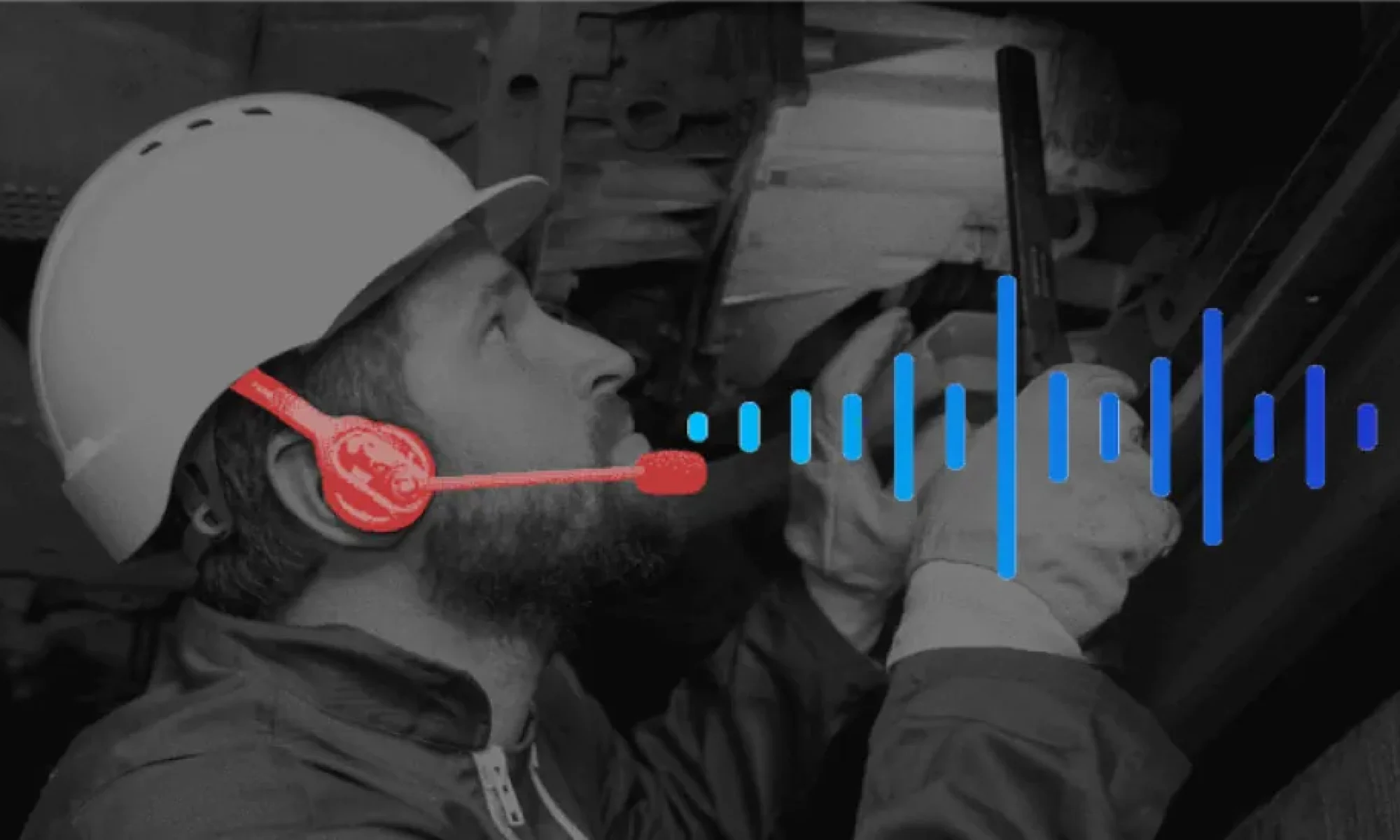
Typing on a tablet during a maintenance operation is not realistic. But talking? Talking happens quite often!
Field operators are already providing the data we’re missing—describing, diagnosing, teaching, and troubleshooting in real time. The problem is, it’s all for naught, despite numerous attempts at knowledge collection, knowledge capture campaigns, and the generation of technical white papers. While such initiatives have succeeded for sales, design, and engineering intelligence, most have failed at the production level. Something needs to change in this approach!
This is where voice assistance discreetly comes into play...
Obviously, we’re not talking about Alexa or PlaudNote in the workshop. We’re talking about a robust companion, capable of working offline, designed for a specific and demanding industrial context.
Imagine an operator saying: ” Recording: Pump 2A still vibrating, like last week, high temperature but stable pressure. “
The assistant analyzes this single sentence and transforms it into structured data:
- Equipment: 2A Pump
- Problem: recurring vibrations
- Details: high temperature, stable pressure
- Recommended action: monitor
This simple observation instantly becomes part of the factory’s memory. Multiply that by hundreds of daily observations, and suddenly your factory is not just operating — it’s learning .
Such a continuous, seamless and low-cost learning path is only possible with the introduction of radical changes in data collection, via natural voice interfaces.
Now, when someone asks, ” Did any pumps show repeated temperature spikes before the failure? “
A good on-site artificial intelligence might respond: ” You have 4 pumps that failed after experiencing temperature spikes over the last 3 months, the primary cause identified as recurring vibrations .” Not because the AI “guessed” it, but because someone captured the truth in real time three months ago .
It is industrial intelligence that is becoming digital, and finally available for artificial intelligence applications.
And that’s where Small Language Models (SLMs) come in (you see, Artificial Intelligence!) — not the massive, cloud-dependent models, but smaller, specialized models capable of running on local devices, handling noisy environments, and understanding half-finished sentences. They don’t try to sound human; they simply make humans’ jobs easier.
Voice-assisted SLM can finally bridge the gap between what the factory knows and what its systems understand . They collect the missing context—the why, not just the what—and they do so without the employee ever opening a laptop.
How do we make it operational?
Let us predict your next question, because we know you…
But while voice technology is clearly so useful,
Why isn’t it everywhere already?
There are several reasons – and none of them really have anything to do with the users.
First, there’s the noise . Factories are noisy and chaotic environments, and standard speech recognition systems struggle to handle the interfering sounds, accents, or protective equipment. Then there’s privacy and compliance —many sites prohibit cloud-based recording tools or devices for security or data protection reasons. Finally, there’s connectivity : Wi-Fi in the factory can be unreliable or nonexistent, instantly ruling out most consumer voice assistants.
And finally, cultural trust . Many operators have seen too many “innovation pilots,” and they’ve become skeptical of a new gadget that promises to “save time.” The first time I tried Alexa, she accidentally called me “Susan,” which put me off, and I stopped talking to her for a few months.
So yes, voice has enormous potential in industry – but only if it is designed for the real world: offline, privacy-respecting, designed for noise, and useful enough that workers will want to use it.
Towards industrial intelligence
So, where do we begin to build industrial intelligence in practice?
- Let people express their knowledge
Give technicians a simple, voice-based way to record what they notice — not a new form to fill out, just a microphone that listens, with a clear understanding of its mission.
Make sure to dispel any fears or misconceptions about voice recording from the outset. The sole purpose of a voice AI solution is to collect technical knowledge , structure it, and make it accessible within the company. Nothing more, nothing less.
- Connecting human input to machine data
Connect these oral observations to sensor logs, maintenance reports, and environmental data—in short, your company’s IoT data. This is how you turn anecdotes into knowledge.
For those who are already one step ahead, you can link this human data to your Digital Twins. This invaluable source of information—the workers on the ground—can address the natural obsolescence of your Digital Twins.
- Stay local and reliable
Build small, on-site models that work offline and sync when possible. No one should lose a report because the Wi-Fi went down in the middle of the factory.
The result is not glamorous, but it is powerful: you stop losing knowledge and you start offering your AI something worth learning.
Conclusion
We all like to say ” data is the new oil ,” but where do we draw the line between truly useful data and data that only serves to fill pie charts on a PowerPoint presentation? The real opportunity lies not in adding new dashboards – but in valuing the daily experience of operators as part of the company’s living memory.
Ultimately, the most advanced factories may not be those with the largest AI stack. They will be those that remember their know-how, treat voice and context as high-value data, and build from the ground up. Because yes – artificial intelligence is coming. But it is industrial intelligence that will make it powerful. .
Why adopt voice AI solutions for capturing technical knowledge now? Because artificial intelligence represents an important source of return on investment for industry, but cannot function at its best without industrial intelligence assets.
And perhaps that’s where the real transformation takes us back to the source: when the smartest thing in the factory is not the algorithm, but the living memory of the people who work there.
Point of contact
André JOLY – Managing Director
Tel.: +33 (0)6 25 17 27 94
Email: andre.joly (at) spix-industry.com
Legal entity
Website: spix-industry.com
Linkedin: linkedin.com/company/spix-industry
Simsoft3D SAS – 40 rue du Village d’Entreprises – 31670 Labège (France)
“Voice Experience “, ” SPIX ” and ” SPIX industry ” are registered trademarks of Simsoft3D SAS.